
Why AI Ignores Half Your Instructions (and the 1 Fix That Works)
Why AI skips your middle instructions - and how to stop it.

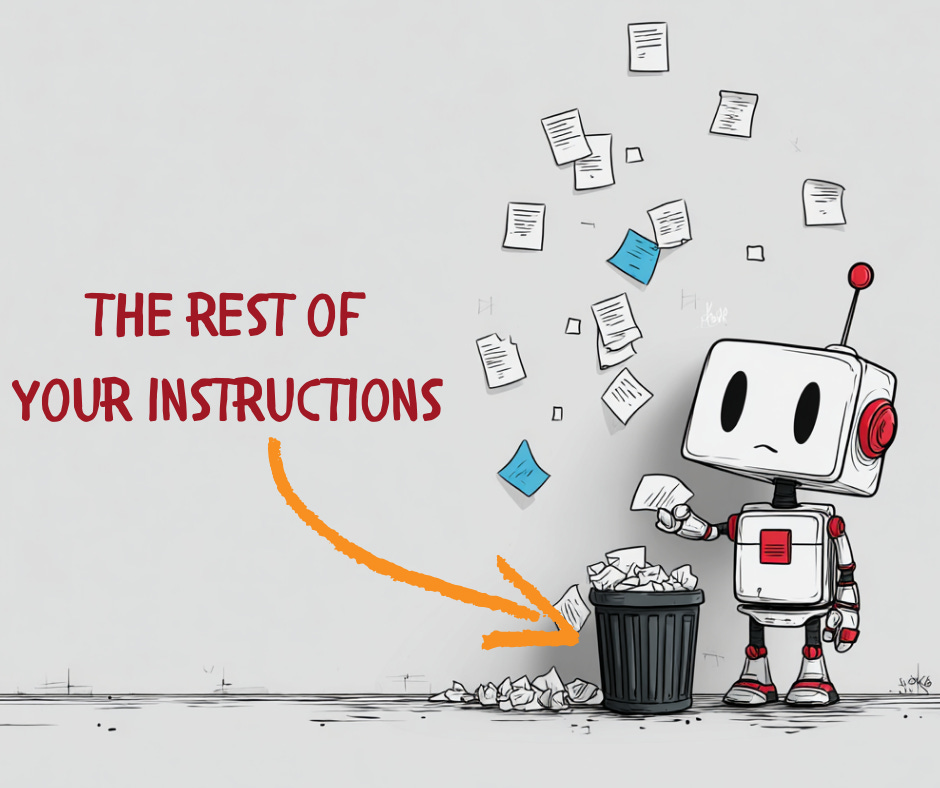
You spend 20 minutes crafting the perfect prompt. You list every requirement clearly. You even number your instructions for clarity.
AI gives you exactly what you asked for... except it completely ignores steps 3, 6, and 8.
You've experienced this frustration:
AI delivers solid work but mysteriously skips critical requirements.
Maybe it builds the dashboard but forgets the filtering options.
Creates the analysis but skips the executive summary.
Writes the SQL query but ignores your specific naming conventions.
It's not random. There's a pattern to what AI "forgets" - and a simple fix that works every time.
Why Smart Instructions Fall Apart
Most data professionals write prompts like they're briefing a human colleague. Detailed paragraphs explaining context, requirements buried in sentences, assumptions that AI will remember everything mentioned.
But AI doesn't process instructions the way humans do. It sees your prompt as a stream of information, not a structured task list. The more complex your request, the more likely important pieces get lost in that stream.
Think of it like this: when you give a human ten things to do, they write them down or mentally organize them.
When you give AI ten requirements embedded in paragraphs, it processes them as flowing text where some details naturally get more emphasis than others.
The parts AI tends to "forget" follow a predictable pattern.
Requirements mentioned in the middle of long explanations.
Instructions that feel optional or suggestive rather than mandatory.
Steps that seem like "nice to have" extras rather than core deliverables.
Your detailed, thoughtful prompts are actually working against you.
The Checklist + Numbered Instruction Method
The solution isn't writing simpler prompts. It's changing how you structure complex ones.
Here's the method that ensures AI follows every instruction:
Start with the task overview, then add your mandatory checklist.
Template:
[Brief task description]

Before you begin, confirm you understand these MANDATORY requirements:
1. [First critical requirement]
2. [Second critical requirement]
3. [Third critical requirement]

Now complete the task following this exact sequence:
1. [First action step]
2. [Second action step]
3. [Third action step]
The psychology here matters. "MANDATORY requirements" signals these aren't suggestions.
The confirmation request forces AI to acknowledge each point. The numbered sequence prevents steps from getting lost in flowing text.
Before and After: Real Examples
Before (Gets Partial Results):
"Create a customer segmentation analysis for our Q3 data.

I need it to be thorough and include demographic breakdowns, purchasing behavior, and seasonal patterns.

Make sure to exclude test accounts and focus on revenue impact.

 The output should be presentation-ready for our executive team next Friday, with clear visualizations and actionable insights they can understand quickly."
After (Gets Complete Results):
"Create a customer segmentation analysis for our Q3 data.

Before you begin, confirm you understand these MANDATORY requirements:
1. Exclude all test accounts from analysis
2. Include demographic, purchasing, AND seasonal pattern breakdowns
3. Create presentation-ready output for executive audience
4. Focus specifically on revenue impact insights

Now complete this analysis following this exact sequence:
1. Clean data and confirm test account exclusion
2. Run segmentation analysis with all three breakdown types
3. Create executive-ready visualizations
4. Write actionable insights summary for leadership team"
What changed:
The requirements went from buried suggestions to explicit mandates.
The steps became a clear sequence instead of flowing description.
Result: AI follows every instruction instead of cherry-picking what seems most important.
When Things Still Go Wrong
Even with perfect structure, AI sometimes skips steps. Here's your troubleshooting playbook:
If AI skips early steps: It's rushing to the "interesting" parts. Add this phrase:
"Complete each step fully before moving to the next one."If AI skips final steps: It's hitting cognitive load limits. Break your request into two separate prompts:
"First, complete steps 1-4. Then I'll ask you to complete the remaining steps."If AI modifies your requirements: You used suggestion language. Replace phrases like "try to include" or "it would be good if" with "you must include" or "requirement."
The nuclear option when nothing works: Add this line at the end:
"Before providing your response, list each numbered requirement and confirm you've completed it."The Advanced Move: Instruction Verification
For critical work, add this verification step to any complex prompt:
"After completing the task, provide a completion checklist showing:
✓ Requirement 1: [how you addressed it]
✓ Requirement 2: [how you addressed it]

✓ Step 1: [confirmation of completion]
✓ Step 2: [confirmation of completion]"
This forces AI to review its own work against your requirements. It catches omissions that would otherwise require another round of clarification.
Why This Transforms Your AI Conversations
This isn't just about getting complete responses. It's about trust.
When you know AI will follow every instruction, you start giving it more complex, valuable work. You stop second-guessing what might get lost. You move from simple questions to sophisticated analysis requests.
More importantly, this structured thinking improves how you approach any complex task, not just AI conversations. Breaking requirements into explicit checklists and sequential steps makes your communication clearer with human colleagues too.
The data professionals getting the most value from AI aren't necessarily writing better prompts. They're thinking more systematically about what they need and how to structure requests for consistent results.
Try It in Your Next AI Conversation
Take your last multi-step prompt where something got missed. Rewrite it using the checklist + numbered sequence method.
Copy both versions into AI and compare the responses. You'll immediately see how structure changes completeness.
Save the better version and use it as your template for similar requests.
Did you find this issue helpful?
What instruction does AI miss most often in your prompts? Hit reply and let me know - these patterns often reveal solutions I can share with everyone.
Chat soon,
Donabel