
The Flip.
What changed when I stopped driving every Claude conversation - and started building with it.


The list of things I want to try keeps getting longer.
New workshops to design. Classes to revamp.
Tools I want to build - some for students, some just out of curiosity.
I should probably feel overwhelmed by it. I don’t. I feel like I can’t get to the next idea fast enough.
That started when I moved from the Claude web interface to Cowork. Not because of any one feature. Because of what the whole setup did to my sense of what’s actually possible. Not what Claude could do. What I could suddenly see it doing.
And it started with one shift: I stopped being the only one asking questions.
Stop Driving. Let Claude Ask.
This article is a live example of what I’m about to describe.
Before writing it, I started where I always start: raw notes.
Topic ideas, angles I was considering, things I’d actually tried. Not polished. Just the material I had.
Because my context files and skills were already loaded in Cowork, Claude already knew my voice, my audience, my preferences - I didn’t have to re-explain any of that. What I needed help with was shaping the raw material into something specific.
That’s where AskUserQuestion came in - a tool in Cowork that flips the dynamic: instead of you prompting Claude, Claude prompts you. It asks targeted questions, gives you multiple choice options for the big decisions (format, angle, emotional core), and a free-text field for anything that doesn’t fit the choices. The options gave me something to react to instead of a blank box to fill. By the time I’d answered three questions, I knew things about this article that I hadn’t fully worked out on my own yet.
The raw notes gave Claude enough context to ask the right questions. The questions helped me figure out what I actually wanted. That combination is faster than either one alone.
You don’t need Cowork to get a version of this. In any Claude session:
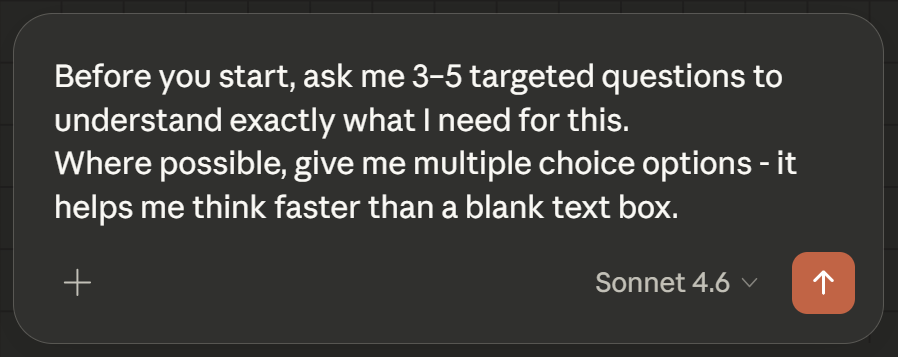
If you’re already providing raw notes or context, even better - tell Claude that upfront. The questions it asks will be sharper for it.
For educators, this clicks fast.
Instead of explaining your entire course context before asking Claude to write a rubric, you answer a few focused questions.
Instead of describing a dataset scenario from scratch, Claude asks you what it needs to know first.
A companion habit I’ve built alongside this: before any substantial task, I tell Claude not to start yet.
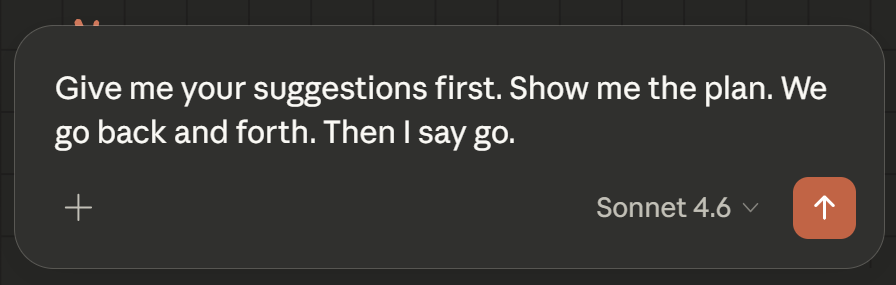
It means I’m never redirecting from a full draft I didn’t want - because we agreed on direction before anything was built.
Build Your Context Once. Use It Everywhere.
Here’s what I used to do: open a new Claude session, re-explain myself, re-state my audience, re-describe my voice, re-clarify what I was building. Every session. From scratch.
Now I don’t.
My about-me file, voice profile, and writing style guide live in Cowork’s context. They blend into the background of every session. Claude knows I teach, that I write for data professionals and educators, that I hate the word “delve,” and that I'd rather cut a paragraph than publish something that doesn't sound like me.
I didn’t say any of that today. It was already there.
This is the part of AI tool setup that gets skipped: the one-time infrastructure.
Build it once.
Load it.
Then stop explaining yourself and start doing the actual work.
The thing that got mine started was Ruben Hassid’s piece “I am just a text file” - a 100-question interview prompt designed to extract the DNA of how you think, write, and see the world in enough detail that Claude can actually use it. I didn’t use Wispr Flow to answer it like Ruben recommended (security concerns - still need to research this). I typed. All of it. Raw, unpolished, slow.
That turned out to be its own kind of thing. A hundred questions about how you write, what you believe, what makes you cringe - you surface things about yourself you hadn’t explicitly thought about. Not all of it was comfortable. Some of it was clarifying in a way that surprised me.
That document became the foundation of my context files. It’s evolved since then - and the evolution is part of the point.
Your Skills Should Be Getting Smarter. Are They?
I built my first Claude skill - a reusable instruction set that tells Claude how to handle a specific type of task - by following someone else’s guide and asking Claude itself a lot of questions.
What’s a skill?
What should go in one?
Can you show me an example?
Claude was patient. The learning was faster than I expected.
The substack-article-guide skill I used to shape this article is one example. It holds the format rules, the voice requirements, the structural spine for guide-style pieces. But what changed how I think about skills came after the first build.
Skills don’t do all the work, and they shouldn’t.
Every article I write, every session I run - something evolves. My taste gets sharper. I change my mind about something. I figure out a better way to say what I mean. The skill is a snapshot of what I wanted when I built it.
What I want now is always slightly ahead of that.
So after most sessions where a skill was used, I ask this:
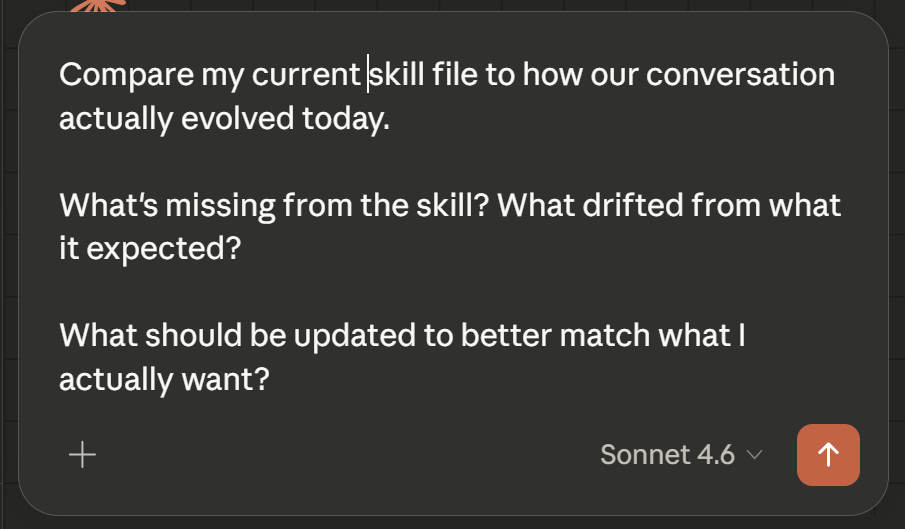
The gap between “what the skill said” and “what the conversation actually produced” is information. Sometimes it means the skill needs updating.
Sometimes it means I’ve changed - my thinking, my standards, what I’m going for.
This shows up in small ways.
I built a voice profile documenting phrases I thought I liked. Then I started noticing, mid-conversation, that I actually didn’t - that I’d been reaching for them out of habit, not preference. Claude caught the pattern before I consciously named it. That kind of feedback loop doesn’t come from a static document. It comes from using it, watching what actually survives editing, and asking Claude what it’s observing.
It ends up feeling less like maintenance and more like self-discovery that happens to produce a better skill file.
What Building (Not Just Prompting) Actually Looks Like
The project I’m most excited about right now isn’t a writing skill. It’s a dashboard review app.
The idea: upload a screenshot of a dashboard, answer two questions (who’s the audience, what decision should this support), and get structured feedback organized by category - clarity, chart choice, story and flow, color and design.
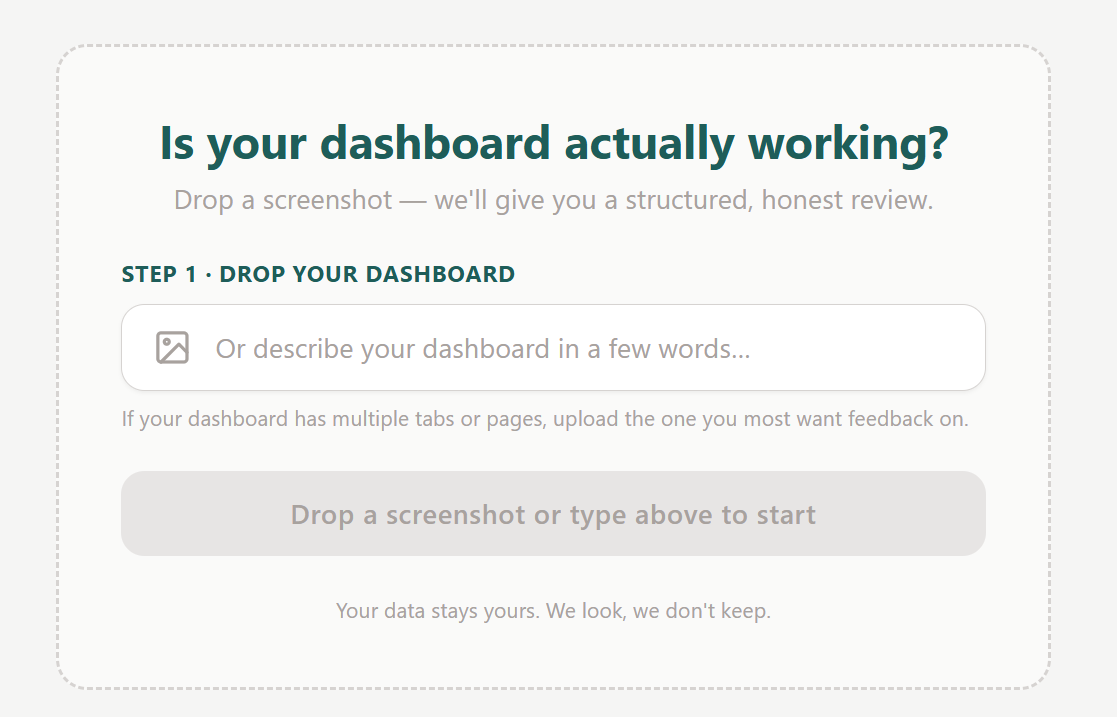
A scorecard, a story gap analysis, specific findings, and one quick win you can act on in 10 minutes. No vague encouragement. Real critique, available at 11 PM when no instructor is around.
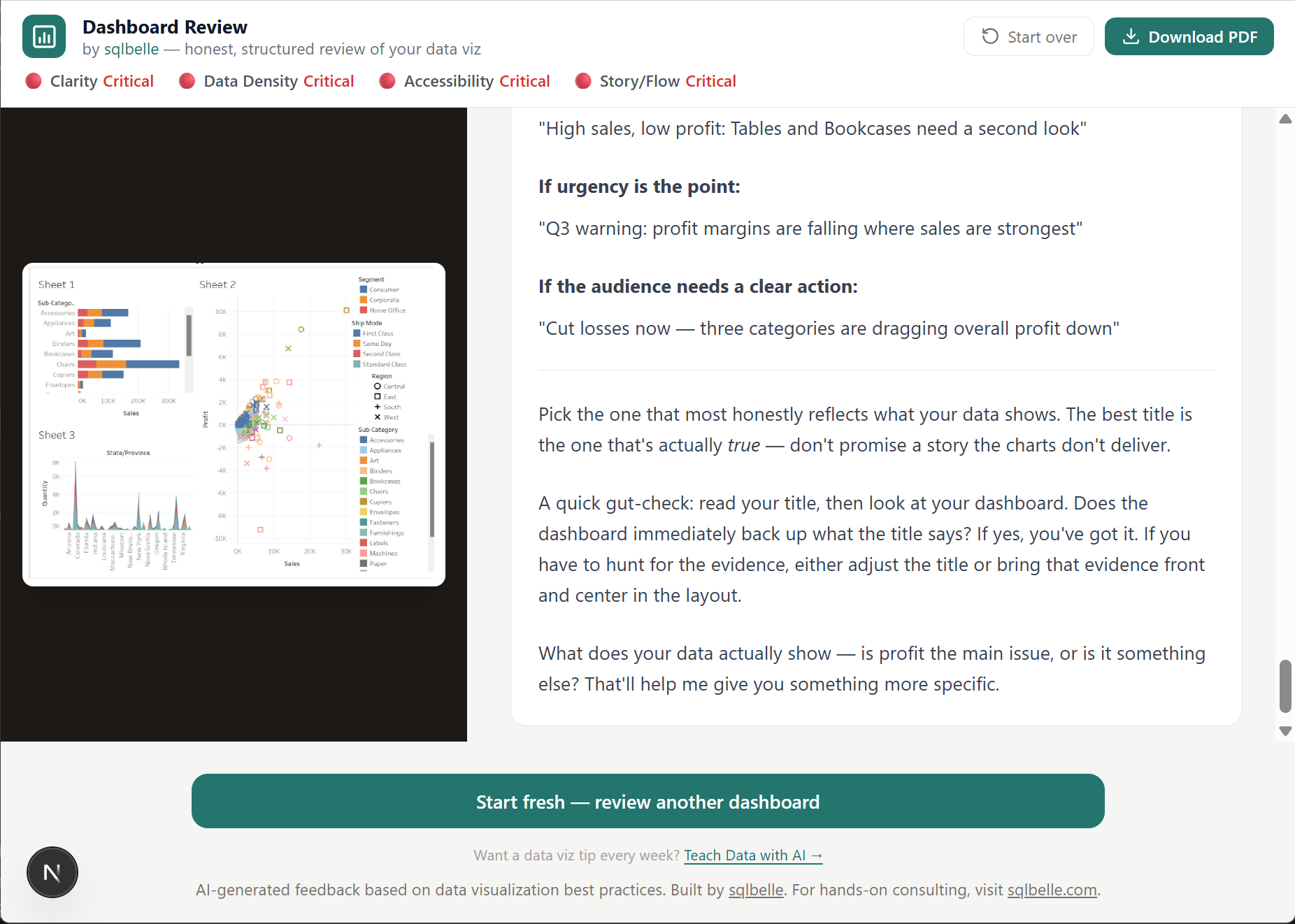
I built a working prototype using Google Antigravity with Claude as my coding partner - Nick Saraev’s vibe coding walkthrough on YouTube is what made the setup click for me. It runs locally, not deployed yet. But it works.
The hardest part wasn’t the code. It was getting the system prompt right. The UI is scaffolding. The judgment is in the prompt.
I would not have built this - would not have even believed I could - without the setup I’ve described here.
One thing I haven’t figured out yet: voice dictation.
I’ve watched others use locally hosted transcription to talk through raw ideas instead of typing - faster, more natural. I haven’t implemented it because of privacy concerns. It’s still in the queue. I’m not moving on it until I’ve thought it through properly. That’s the honest version.
The Signal
That couldn’t-stop-thinking feeling hasn’t gone away.
It’s just shifted - some weeks it’s a feature I want to test, some weeks it’s something I built that worked better than I expected, some weeks it’s a conversation that made me realize a skill needed updating.
I don’t think it’s about Cowork specifically. It’s what happens when you move from using a tool to building with one. The line between those two things is smaller than it looks - and crossing it changes what you think you’re capable of.
Token limits will interrupt you. Some experiments won’t work. Some builds will stall out and wait on a shelf until the next piece falls into place.
All of that is true.
But the imagination doesn’t go back to where it was.
Every week in Teach Data with AI, I write about what I’m actually building - the experiments, the prompts, what’s working and what’s still in progress. If that sounds like what you’ve been looking for,subscribe here.